
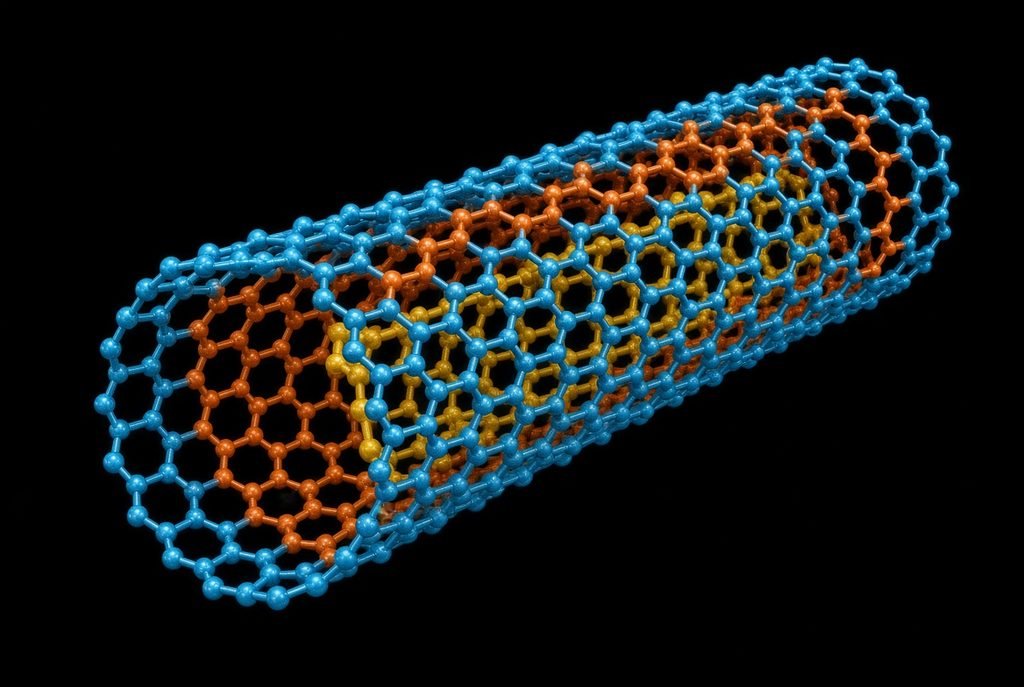
Scientific illustration | Generated by ys-carbon
Carbon nanotubes offer near-theoretical strength, exceptional thermal conductivity, and high carrier mobility. Yet in composites, sensors, batteries, and transistors they frequently fall short of expectations. The reason is almost always the same: uncontrolled bundling. Without high-quality dispersion, the intrinsic properties remain locked inside agglomerates.
Here is a clear, research-supported overview that connects fabrication quality with the dispersion strategies that actually deliver performance.
🔍 The Fundamental Problem Whether CNTs come from arc discharge, laser ablation, or CVD, strong van der Waals forces cause them to form tight bundles. These bundles reduce effective aspect ratio, scatter electrons, and ruin processability. Dispersion is therefore the critical bridge between growth method and final application.
💡 Solvent Selection Is Still Decisive Matching Hansen solubility parameters remains the most reliable starting point.
- Proven solvents: DMF, NMP, DMSO
- Emerging sustainable alternative: Cyrene (higher dispersion concentration and better filtration efficiency than NMP)
Stable sources:
- Multicomponent solubility parameters for SWCNTs (Bergin et al., ACS Nano 2009)
- Sustainable nanomaterials: the role of Cyrene… (Frontiers in Chemistry 2024)
⚡ Energy Input + Stabilization Methods
- Controlled sonication supplies the energy needed to open bundles while limiting tube damage.
- Non-covalent surfactants or mild functionalization keep tubes stable in aqueous systems.
- Protocol intensity must be matched to the crystallinity of the starting material (high-crystallinity arc-discharge or laser-ablation tubes require gentler conditions than typical CVD material).
Key reviews:
- Dispersion of carbon nanotubes in water and non-aqueous solvents (RSC Advances 2013)
- Role of Solvent Polarity on Dispersion Quality and Stability of Functionalized Carbon Nanotubes (Polymers 2022)
📊 Where Proper Dispersion Delivers Clear Gains ✅ Polymer and metal composites — higher modulus, conductivity, and electromagnetic absorption once networks are uniform. ✅ Flexible sensors — faster response and higher sensitivity in CNT–polymer or CNT–MXene hybrids. ✅ Energy-storage electrodes — continuous electron pathways and better volume-change buffering in Li-ion, Li–S batteries, and supercapacitors. ✅ CNTFET electronics — dense, aligned semiconducting arrays become practical only after high-quality dispersion and sorting.
Supporting literature:
- Dispersion Stability of Carbon Nanotubes and Their Impact on Energy Storage Devices (Inorganics 2023)
- Improving Dispersion of Carbon Nanotubes in Natural Rubber… (Polymers 2023)
- Research Progress of Carbon Nanotube Fabrication and Applications (Zhang et al., Micronanoelectronic Technology, 2026)
✅ Bottom Line Regardless of the growth route you choose, dispersion quality ultimately decides how much of the theoretical performance reaches the final product. Treat it as a core process, not an afterthought.
For more related content and research updates, please visit my official website.
📚 Verified Stable References
- Dispersion of Carbon Nanotubes in Liquids (Hilding et al., 2003) → https://www.tandfonline.com/doi/abs/10.1081/DIS-120017941
- Dispersion of carbon nanotubes in water and non-aqueous solvents → https://pubs.rsc.org/en/content/articlelanding/2013/ra/c3ra43852j
- Multicomponent solubility parameters for SWCNTs → https://pubs.acs.org/doi/10.1021/nn900493u
- Determination of solubility parameters of SWCNTs & DWCNTs → https://pubs.rsc.org/en/content/articlelanding/2013/ra/c3ra40382c
- Cyrene for CNT dispersion → https://www.frontiersin.org/journals/chemistry/articles/10.3389/fchem.2024.1498279/full
- Dispersion Stability & Energy Storage → https://www.mdpi.com/2304-6740/11/10/383
- Multiple light scattering mini-review → https://www.sciencedirect.com/science/article/pii/S2215038222001054
- Waterjet rubber powder carrier method → https://www.mdpi.com/2073-4360/15/3/477
- Solvent polarity & functionalized CNTs → https://www.mdpi.com/2504-477X/6/1/26
#Nanotechnology #CarbonNanotubes #MaterialsScience #Composites #Dispersion #CVD #CNTFET #EnergyStorage #FlexibleElectronics #Nanomaterials